
The National Credit Act (NCA) and Debt Review go hand-in-hand. The National Credit Act (NCA) introduced Debt Review to over-indebted South Africans in 2007. The question still remains though… What is the NCA?
What is the National Credit Act (NCA)?
The NCA protects you, the consumer (Debtor), when you enter into a Credit Agreement with a credit provider (Creditor).
Applies to all Credit Agreements entered into in South Africa. Some of these can take the form of:
Store Cards
Personal Loans
Credit Cards
Overdraft
All consumers that enter into a Credit Agreement have to read through all the Terms and Conditions
Ensure understanding of Your Rights & Responsibilities
Which Act Governs The Debt Review Process?
The Act that governs the Debt Review process is the National Credit Act 34 of 2005 and the National Credit Amendment Act 19 of 2014.
Who Is Affected By The NCA?
Consumers
The person who purchases services or goods on credit OR obtains a loan with a Credit Agreement
Credit Providers
The person or institution (Credit Providers) that agrees to OR lends money under a Credit Agreement.
The Credit Provider has to be registered with the National Credit Regulator (NCR)
Any person OR institution that is NOT registered under the NCA may NOT offer OR enter into a Credit Agreement with a consumer
Credit Bureaus
What Are My Rights And Responsibilities As A Consumer Under The NCA?
Your Rights
You have the right to apply for credit
The Credit Provider has the right to decline your application if they have reasonable grounds to do so
You have the right to be given a reason if your credit application has been declined
You have to be supplied with a reason within a reasonable amount of time after the request has been lodged
You have the right to be protected against discrimination, of any sort, when applying for credit
This protects you against discrimination based on race, gender, marital status etc.
You have the right to be protected against Reckless Lending by the Credit Provider who has to establish if you are able to repay the credit you have applied for and understand:
The costs of the Credit Application
The risks associated with your Credit Application
Your Rights and Responsibilities under the Credit Agreement
Your repayment history
Your existing financial situation
You have the right to receive a detailed costing of the amount, interest rate and any other charges under the Credit Agreement
You have the right to receive all documentation and information in understandable language so that you can make an informed decision when entering into a Credit Agreement
You have the right to receive all your documents and information in an official language that you can read and understand all the information provided
You have the right to receive all information and documents in a manner prescribed by law OR as chosen by you
Ie – by post, email, fax or in-person etc.
Your Responsibilities
It is understood that if you have rights, there are always corresponding responsibilities that apply to you too. These are:
You have the responsibility to make all payments in terms of your Credit Agreement
You have the responsibility to inform your Credit Provider of any change of address
The address where the goods you have purchased under the Credit Agreement are kept
The address where the goods you have purchased under the Credit Agreement is stored on your behalf
You have the responsibility, to be honest when providing a Credit Provider with your information
You have the responsibility to comply with YOUR responsibilities set out in the Credit Agreement
Insure Goods
Take Care of Goods
If you are married In Community of Property, you must have the written consent of your spouse BEFORE you apply for credit
If you default on your Credit Agreement you:
Need to contact the Credit Provider and make arrangements with them to bring your payments up to date
Can apply for Debt Review with a registered Debt Counsellor such as Basson Debt Counselling
Can contact a Dispute Resolution Agent, Ombudsman or Consumer Court to resolve any dispute OR negotiate and agree to a plan to bring your payments up to date
Will become liable for any administration costs or legal fees if legal action is taken against you due to the default as well as collection costs
You have the right to request and be supplied with a FREE replacement copy of documents
Frequent requests for these documents will incur a fee
You have the right NOT to be held liable for the use of your Credit Facility after you have reported the loss or theft of your card, PIN etc.
You have the right to apply for Debt Review if you can not afford to repay your credit
You have the right to surrender your goods
In order for the Credit Provider to sell OR settle your outstanding amount
You have the right to access and challenge information held by a Credit Bureau
You are able to request this information, FREE, once a year (12-month period)
You have the right to receive statements of account on a regular basis which include your:
Current Balance
Amounts Paid
Charges and Next Instalment Date
You have the right to protection of information
Credit Providers must treat your information as confidential and ensure that it is only used for the purpose that you consented to, including marketing material
You have the right to be notified before a Credit Provider submits negative information about you to a Credit Bureau
What Is Debt Review?
Debt Review was introduced by the NCA in 2007 as a relief measure for over-indebted South African consumers who are struggling to make their monthly payments. If, after conducting a financial assessment, the Debt Counsellor finds that you are over-indebted, they will start negotiating with your credit providers.
These negotiations will include the reduction of payments and once agreed to, the restructuring of your debt will commence. This will all be confirmed by the Magistrate Court OR the National Consumer Tribunal (NCT) by means of a court order OR consent order.
What Is A Debt Counsellor?
A Debt Counsellor (DC) is a person who is registered with the National Credit Regulator and who has received the required training and knowledge to assist you, the consumer, through the Debt Review process. Every registered Debt Counsellor is issued a Registration Certificate and you are able to request proof of this at any time.
Remember, it is YOUR responsibility to ensure that your Debt Counsellor is registered with the NCR and you can do this by visiting the NCR web page and filling in their name or the NCR registration number they have provided to you. Basson Debt Counsellors is registered with the National Credit Regulator and our registration number is NCRDC964.
What Is The Debt Review Process?
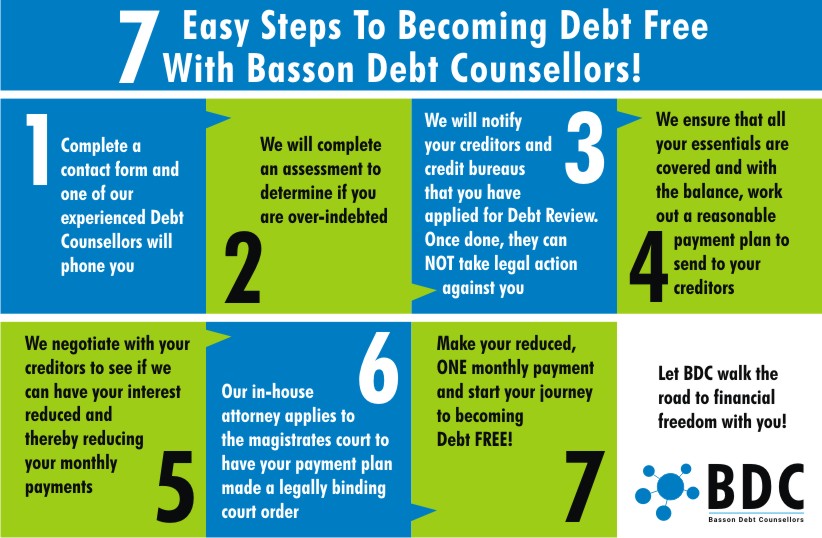
Applying for Debt Review is not as hard as people think and here are the steps that you will go through in the process:
Application for Debt Review
The Debt Counsellor conducts an assessment of your financial situation
The Debt Counsellor negotiates with your creditors
Your Debt Counsellor restructures your debt into affordable payments after ensuring your basic living expenses are also catered for
You start the process of paying only 1 monthly payment which is distributed to your creditors by a registered PDA (Payment Distribution Agent) as regulated by the NCR
Once you have successfully completed the Debt Review process and all your debt has been cleared, your Debt Counsellor provides you with a Clearance Certificate
If you would like to read a more in-depth article on the Debt Review process, click here.
Where Can I Complain About Credit-Related Disputes
It is always recommended that you try to resolve any complaint with the person or institution that has caused the complaint before referring it somewhere else and escalating the situation. Communication is key and the responsibility of you and your credit provider.
If for whatever reason this does not resolve the dispute relating to Credit OR a Credit Agreement and the NCA, you are able to lodge a complaint with the NCR. These disputes could be regarding the service of:
A Credit Provider
Credit Bureau
Debt Counsellor
As the NCR is an independent body that regulates the credit industry, they will either:
Issue a Notice of Non-Referral
Refer the complaint to
A Debt Counsellor
The Relevant Ombudsman
A Dispute Resolution Agent
The Consumer Court OR
Investigate The Complaint Themselves
Once the NCR has investigated the dispute/complaint, they will do one of the following:
Issue a Notice of Non-Referral
Apply to the National Consumer Tribunal (NCT) or an order
Refer the dispute to the NCT OR a Consumer Court OR
If the dispute relates to an offence in terms of the NCA, they will refer the matter to the National Prosecuting Authority (NPA)
If the NCR has issued a notice of non-referral or if you are unhappy with the decision of the NCR, you are able to:
Refer the matter to National Consumer Tribunal
The NCT is an independent body that is similar to a court
The complaint needs to be lodged by completing the correct complaint form and lodging it within a prescribed period of time
The NCT will hold a hearing which will result in an appropriate order and/or penalty – be it for OR against the body that was complained about
The NCT has to provide reasons for the order
Refer the matter to the Consumer Court